Spolia of a Thousand Expectations
A journey through an alternative cityscape of a contemporary metropolis
- Year
- June 2017
- Medium
- Rotring pen on museum board
- Size
- 82 x 67 cm
- Collaboration
- Story in collaboration with philosophers, architects, urban planners and the artist collective STALKER, and Peter T. Lang, architectural theorist and historian
- Collection
- Acquired by the Gemeentemuseum The Hague
- On view now
- Upcoming
- Museum editions
- Available as a limited giclée edition. View in the shop
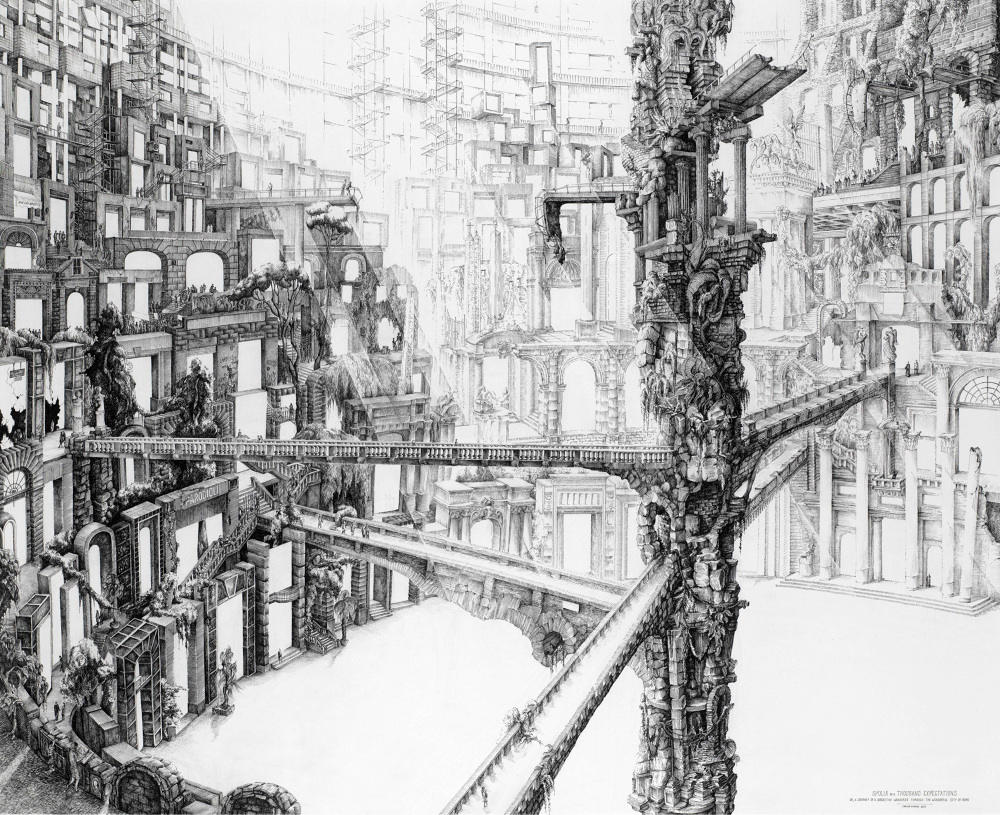
I take you on a journey through the map Spolia of Expectations. A map of an alternative cityscape of Rome, the eternal city. This map investigates how urban identity is formed, who has a say in it, and who can lay claim to it. The portals and windows around the central column came about from just as many encounters during long walks across Rome, all the way to the edges of its periphery. During these walks I was accompanied, in turn, by a theorist from the 1960s architecture practice Superstudio, by an architect and activist from the research collective Stalker, by the city poet of Rome, or by the city photographer of De Volkskrant. Bottom left, I am shown drawing, as an outsider who, navigating through the eyes of all kinds of Romans, experiences and reflects on the city for months on end. Born from wonder rather than knowledge, this subjective cityscape of Rome came into being, as spolia of its identity.
Spolia, in the Latin sense, can refer to war plunder or a stripped animal hide — stolen from the culture it belonged to, or from the body that made it — torn from its context and carried off to be shaped into something new. In architecture, spoliation means the reuse of fragments from an earlier era.
Everything in this map is a constellation of spolia, fragments of other times and places that together form a whole. The central column symbolises the city as a postcard: the archetypal image of Rome, built up from recognisable historical spolia such as the classical literature at its foot and the columns of the Roman Empire, surrounded by the romance of decay. The column is really an illusion, a flat version of Rome's identity. Moreover — does "the" identity perhaps not exist at all?
The arena, or the Colosseum, around the column consists of the windows that depict all the other perspectives on what Rome is, seen from all its diverse inhabitants and users. It investigates the complex sum of reflections on the city. All these reflections together, all these perspectives on what Rome is, form a shifting patchwork of identities. Perhaps this patchwork comes closest to its true identity, a most characteristic spolia.
All the windows, all the people I spoke to, have a place in the structure of Rome and thus a certain distance to the spolia in the centre. The further away, the less say in the city's identity-formation, the less right to a place in the city.
At the front you see the windows that most directly reflect and shape the city's archetypal identity. To the right, at the front of the empty square, stand the somewhat crumbling but still mighty columns of the Vatican, closely connected to the spolia column. Further to the left, the historic villas of the chic Parioli district, almost devoid of life, now merely a parody of themselves. The Pantheon, too, which represents a time when intellect and free thought were a fundamental value in urban development, is located not far from the column, but today only exists as a tourist experience.
For these historic, powerful and wealthy locations there are direct connections to the spolia, while the access bridges from other parts of the city have collapsed. Originally, Rome is a city of strangers, that existed by the grace of newcomers who came for trade and employment. It was a city that developed neighbourhoods for emancipated slaves and was proud of its growing diversity. Today, important historic immigration routes such as Via Casilina and Via Prenestina, in the top right of the map, no longer lead to the city's image-defining identity. People with suitcases are guided behind the image of the nineteenth-century king Vittorio Emanuele II on Piazza Venezia, towards elsewhere. Between empty factories they pitch their tents — hang photos in the trees and draw squares in chalk on the ground — people go far for a feeling of home. At the top of the periphery stretches the Corviale, an almost kilometre-long modernist block of social housing that today stands partly empty and is squatted. Forgotten by those who do have influence over the city, it offers a place for the oppressed.
As the periphery takes up an ever-larger part of the city, the windows further from the identity column are reflected less and less. Not only do the houses on the margin literally have the smallest windows; the Roma, immigrants, students and workers also get the fewest chances of an existence in today's Rome, which is increasingly dominated and populated by tourists, so that only the richest Romans can still really live in the city. In the end, only a few still have a choice, and people are forced to move away from the centre out of necessity: further out, students displace the social underclass, and the social underclass displaces the immigrants.
Because the old centre is being cleared for tourists, these temporary passers-by gain the exclusive right to the story of the city. But this ready-made, sellable identity no longer seems to develop further. While the city, out of the tourist's sight, continues to decay on the outside, the central image at the front increasingly becomes the ghost face of a museum-city — or the flayed skin of a once-living organism. European cities have degenerated into the antique backyard of the world. They no longer renew themselves if they offer no opportunities to people looking for a future, who want to make a new place to call home, from students and starters to immigrants. For a city's identity, polluting, unmoored, consuming tourist flows may well pose a far greater threat than immigrants.
Who is allowed to feel at home in the city? Who is allowed to appropriate the city's identity and update it? In our flexible, digital, networked world, more and more people find themselves adrift. In search of a home, a meaningful job, marketable skills, and a place to build on.
The most symbolic of the spolia on the central column is perhaps the statue of Pasquino. The male figure, top left, without arms, was for centuries the place where people had the right to voice criticism of the city. They could post notes on the statue with their insights and views on governance and policy. This so-called "talking statue" thus formed a democratic apparatus, a way for citizens to have a say, and a suggestion box for the city's leaders.
Perhaps we can come to see the column in the centre as a new Pasquino, a place for that ever-changing identity, instead of a fixed image. A collection of stories, expectations and possible solutions. And, by repairing the broken bridges, a place for new forms of civic participation. Rome's diversity is not only distant history, but perhaps also the key to its rich future. A future in which everyone gets the chance to create a home and collectively help shape the story of the city. Because only in this way do new influences and perspectives keep flowing into the city, continuously renewing and nourishing its identity. The strongest identity is polyphonic, resilient and ever-changing. A talking statue that listens to everyone about who she is and what her expectations are. An identity that is continuously being built, in which graffiti, the cultures of immigrants, and modernist facades can also be found.