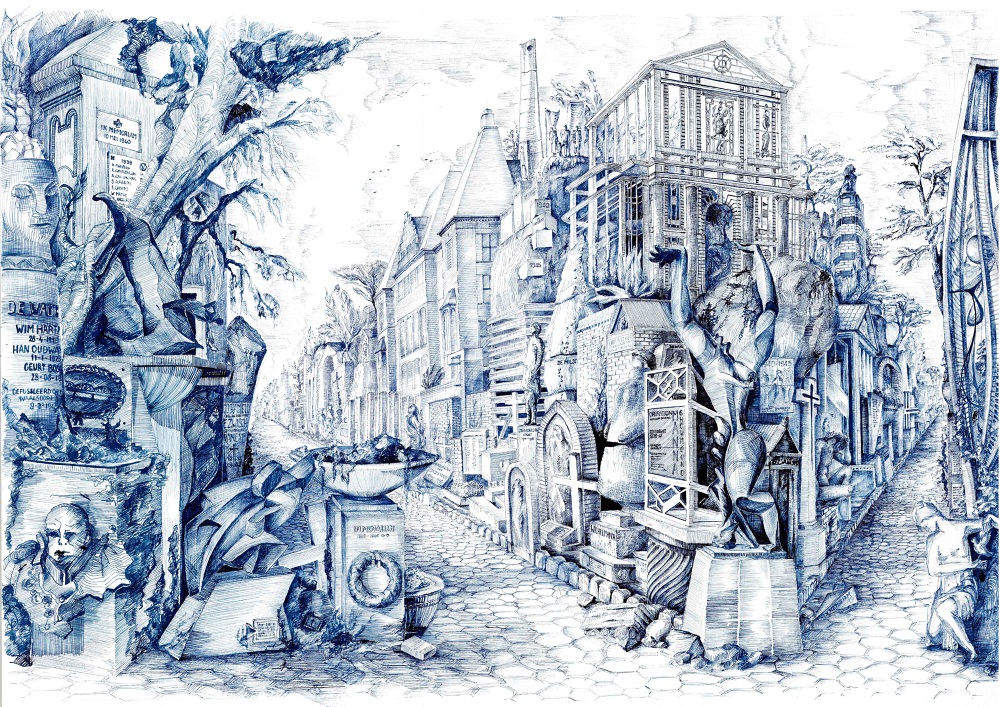
Memorial for a Memory
For those who grow tired of plastic vanity, for all who are sick of the foam-rubber life, or a park for those who still want to believe in heavy stones that are hard to move
- Year
- Rotterdam, 2016
- Medium
- Rotring pen on museum board
- Size
- 65 x 48 cm
- On view now
- Upcoming
- Museum editions
- This edition is sold out.
After the death of the person being commemorated, a monument dies twice. First when we forget its story. Then it can still be saved, by telling the story again. It dies for good the second time, when it is destroyed.
In the city of Rotterdam, where almost everything old has been suppressed or replaced by the new, a number of monuments to the Second World War remain. 77, to be precise.
By now the war was almost 80 years ago, and fewer and fewer people still remember it. Meanwhile, the monuments are slowly but surely starting to disappear from the city. Cleared away, replaced, broken, or gone. There is only one possibility left for the residents of Rotterdam to preserve these images, to protect our collective memory: we will have to steal the memorials from their pedestals and drag them to the columbarium — to the park we envision in the middle of the city.
Every monument still present in the city today is numbered and linked to a print of this drawing. From now on, you, the owner, carry the responsibility for the monument linked to this print. Then we can only hope that the monuments reach the park, and that everyone protects their fragment — of our collective memory.
As Piranesi once envisioned, the park becomes a wondrous walk, a physical collective memory through the history of Rotterdam, with paths marked by red lights. A large, heavy park, an avenue of memories, a monument to memory itself. An ode to stability, or perhaps simply, an open-air museum for the city's sculpture.
'Memorial for a Memory' is one of the plans from a series of poetic terror. Alongside the park for collective memory, we build a congress for strange beliefs, a secret theatre in service of the uprising, and a rollercoaster for euthanasia. Finally, we occupy an abandoned cellar, for an archive for the vanished ornament, even though it is impossible. After all, what is there left to achieve, except perhaps the impossible?