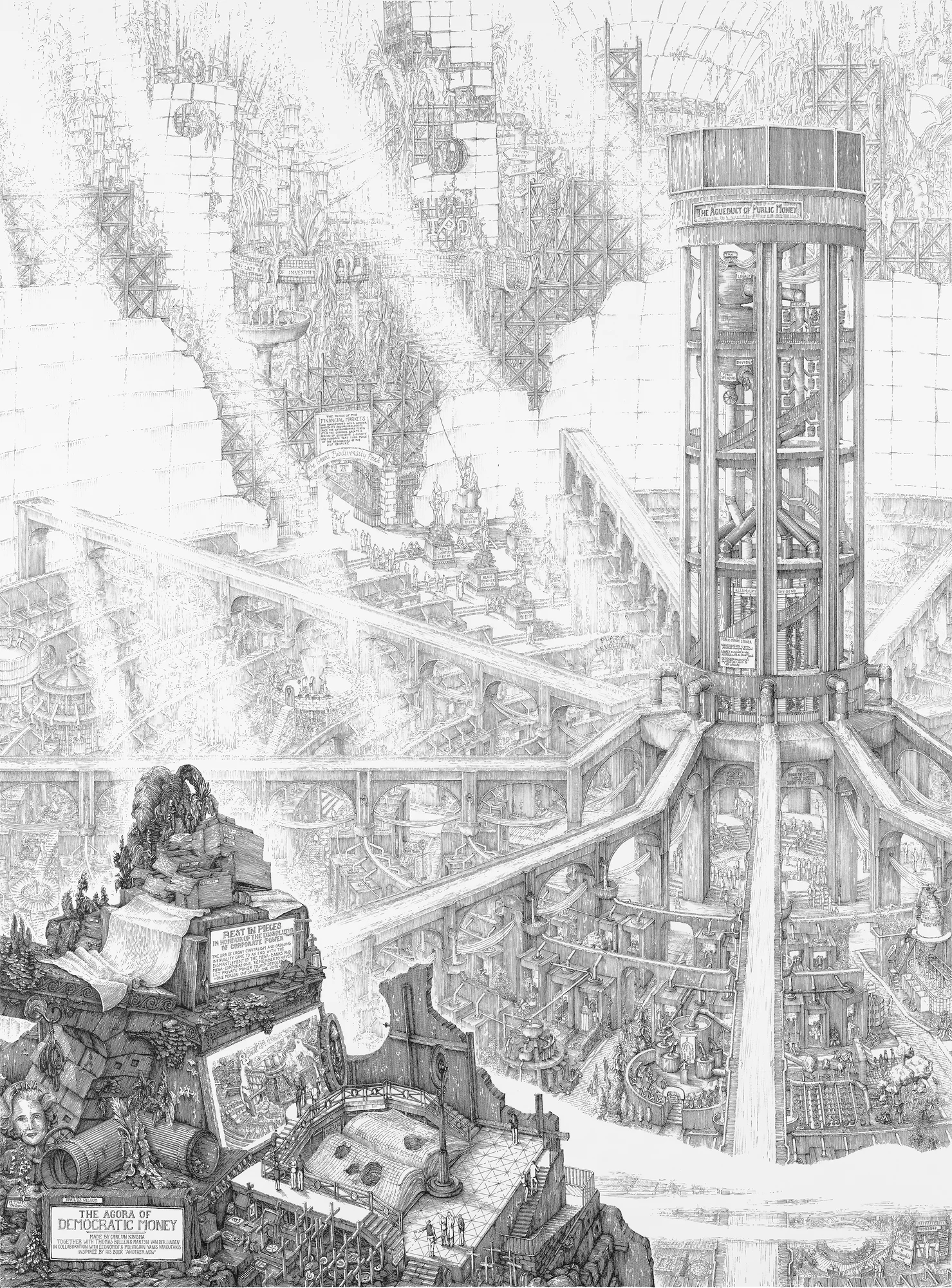
The Agora of Democratic Money
Rest in pieces, in honor of the dissolution of corporate power
- Year
- 2023
- Medium
- Rotring pen on museum paper
- Size
- 76 x 56 cm
- Collaboration
- In collaboration with economist & politician Yanis Varoufakis. A production of cartographer Carlijn Kingma in collaboration with investigative journalist Thomas Bollen and researcher Martijn Jeroen van der Linden
- On view now
- Upcoming
- Museum editions
- Available as a limited giclée edition. View in the shop
Welcome to the Agora of Democratic Money. My name is Costa, I was only a child when the revolution broke out, but my dad and mum told me all about it. They used to be so-called corporate management consultants. After corporate management became obsolete they lost their jobs. It took them a while to get over the embarrassment, but in the end they looked back at their younger selves and laughed about how seriously they took their bullshit jobs. My mum taught me how back in the day people confused “economic growth” with “building a meaningful economy”, two very different things. Follow me and I will show you our new world, where corporate power over democracy has finally ended.
There Is No Alternative
People in the old world knew: shareholder capitalism led to growing inequality and gravely harmed our natural environment. And it was no secret that the economic system was prone to financial instability and recurring crises. Yet all attempts to change the system failed, due to that mantra stuck in people’s minds: There Is No Alternative, or TINA, a phrase coined in the 1980s by British prime minister Margaret Thatcher. For a long time, people were convinced that shareholder capitalism was the only option, apart from dreary Soviet Communism. That was also how my parents saw the world. And between those two, the choice is easy. Under capitalism, at least we all have a chance of improving our lot by one day becoming shareholders ourselves.
Rest in pieces
We’re now standing atop one of the continent’s most popular landmarks—the megabank ruins. Guided tours depart here twice a day. You can also choose to wander freely over the graveyard of the megacorporations. A plaque in front reads: “Rest in pieces. In honour of the dissolution of corporate power”.
The ruins tell the remarkable history of how the megabanks used to operate. They’d spend considerable talent and energy conjuring up complicated trades to boost both share prices and debt levels. This financial engineering fed the frenzy of mergers and acquisitions that created ever-larger corporations, ultimately concentrating wealth and power in the hands of the few.
For a long time, people swallowed the gospel of economies of scale. My parents’ generation believed that corporations had to be large to be efficient—the bigger the better. We now know it’s all a myth. The purported productivity of megacorporations was in fact a coverup—to kill competition, raise barriers to entry, avoid taxes, and above all, maximize profits for shareholders.
From TINA to TATIANA
The Ultimate Financial Crisis marked the turning point. Questionable financial products and dubious loans had been kept off the balance sheets of the big banks for years. Thanks to public subsidies and with central banks turning a blind eye, the bubble grew ever bigger. But eventually the gaps in the books became visible. The ensuing crisis was devastating for ordinary people, and many started to see things differently. The dead-end mantra of TINA became TATIANA: That Amazingly There Is An Alternative.
This new mindset sparked the rebellion for economic change that we still commemorate each year on our biggest public holiday. Celebrations are held in Revolution Square, where statues of the revolutionary heroes gaze out over the revelers. The book Another Now by Greek economist Yanis Varoufakis, which chronicles the rebellion, remains a bestseller. It can be found in the history section of any public library.
A living democracy
Our people have achieved what was long considered impossible: power and capital are now fully dispersed and democratized. Today, citizenship is no longer reduced to casting a vote once every four years, “choosing” between mostly upper-class candidates all schooled at the same elite institutions and distinguishable only by the color of their party logos. Instead, decisions are now made through direct democracy.
Living in a democracy means something again. People have active roles in government and public institutions, taking part in citizen councils and juries selected by lot. I have participated in two councils since I turned 18. One on public housing and another one on how to preserve the slowworm in our local forest. At first I didn’t know what to expect, but it turned out to be interesting. It felt very meaningful to be involved in public decision making.
The aqueduct of public money
Once subject to the whims of megabanks, today’s monetary system is fully democratized and money is treated as a precious common good. The monetary system is designed like a public aqueduct, fully transparent and governed by decentralized committees. Above the entrance to the Monetary Authority an inscription reads: “Beware of power, for it does to ethics what water does to salt.” Various citizen councils manage the money flowing through society, directing it where it’s needed most. The councils assess how investments contribute to society, and then base their decisions on a project’s value for the community, rather than an applicant’s creditworthiness. People can invest their own personal savings in a similar community-minded way, lending out their money in exchange for a share of the profits. This does not give them ownership or voting rights, however. Those rights are retained by each individual employee and cannot be bought or sold.
Public dividends and taxation
The tax system has been greatly simplified: we have a corporate tax and a land tax. Tax deals and exemptions are no longer allowed, in order to end the once so common practice of tax avoidance by the ultra rich. We now look back with bewilderment upon the former imbalance of labor taxation compared to wealth and capital taxes. I still don’t understand why it was that the people who put in so much of their time and effort into the economy, accepted that they also had to pay higher taxes than those who didn’t do anything but own stuff?
Instead of drawing a pension at retirement, everyone now gets a trust fund when they turn 18. In this way we all share in the public dividends on society’s capital. This system largely eliminates that old practice of spending a lifetime moving money around in search of numerical gains, which often had no correlation with tangible benefits for society.
The modern company
Scattered throughout the continent, we see small and medium-sized businesses everywhere, fully owned by employees. And all employees have an equal voice: one person, one share, one vote. Shares can’t be traded, just as your right to vote is yours alone. We’ve achieved something that was inconceivable in the old world: stock markets are extinct, while the economy is booming and more stable than ever.
Companies today have a flat organizational structure, where the principle of one employee, one share, one vote ensures that Big Business is gone forever. Employees found they couldn’t run a company of more than 500 people fairly, so they chose to split up larger organizations into smaller, more manageable ones. Cutthroat tactics and forced takeovers were soon eclipsed by healthy competition and friendly collaboration between these smaller firms, which made for better working experiences—and better results.
During its archaeological studies of business structures in the 21st century, the Citizen Council found evidence of a job—now obsolete—that was once quite popular. The position was called “manager”. Records show that these managers collected high salaries for a job that seems to have consisted mostly of socializing with other managers—in skyboxes, boardrooms, and at exclusive lunches—while the rest of the employees put in long hours to create the actual value. Of course people today look back with perplexity at this level of idleness and unfair remuneration. And with gratitude that nowadays, pay is decided democratically. Every employee is paid a basic salary, plus a bonus that varies from person to person. These bonuses are set collectively, with everyone having a fixed number of merit points to distribute among their colleagues (but not themselves), like the scoring system for the Eurovision Song Contest of old.
Beware of long meetings
When you visit the agora, beware of long meetings. Although everyone is taught how to chair meetings and keep discussions on topic, any place without hierarchies carries a risk of endless debate. The more egalitarian society became, more and more people had time to read and educate themselves. That old academic habit of trying to impress one’s neighbour by quoting at length from the philosophical classics has become a common trait. I have to admit: sometimes I can also be a bit of a show off, causing problematic delays in the decision-making process.
Revolution Square
How did we get here? Well, the statues at Revolution Square remind us of the brave action groups that paved the road to our new world. I don’t know how many bank bailouts it took, but that last one was just one too many. Inequality had reached a point where 10 men owned about 50 percent of our total wealth, and one by one the inhabitants took the path of rebellion. One of the action groups forced governments to introduce stringent limits to pollutants and reduce net-carbon targets to zero. Another one convinced people to stop paying their mortgages and withhold pension payments. Once it had started, the movement was unstoppable. Pension funds were forced to divest and the private banking system collapsed. The established power structure was overthrown.
Central banks had no alternative but to step into the void and provide citizens with bank accounts. After more than three centuries, they finally became a bank for everyone instead of the elite member club for banks.
The Great Biodiversity Park
At the outskirts of the Agora, you can visit the remains of the financial markets, torn down during the revolution. Shareholder capitalism completely misprized our natural habitat and caused untold damage, but nature has shown remarkable regenerative powers. Vegetation is again thriving, taking over the old stock exchanges and money markets. Because the financial markets often flooded due to excess liquidity from banks and central banks, the ground there is so fertile that the area is bursting with biodiversity and lush new growth. It is my perfect destination for a lazy Sunday afternoon walk.