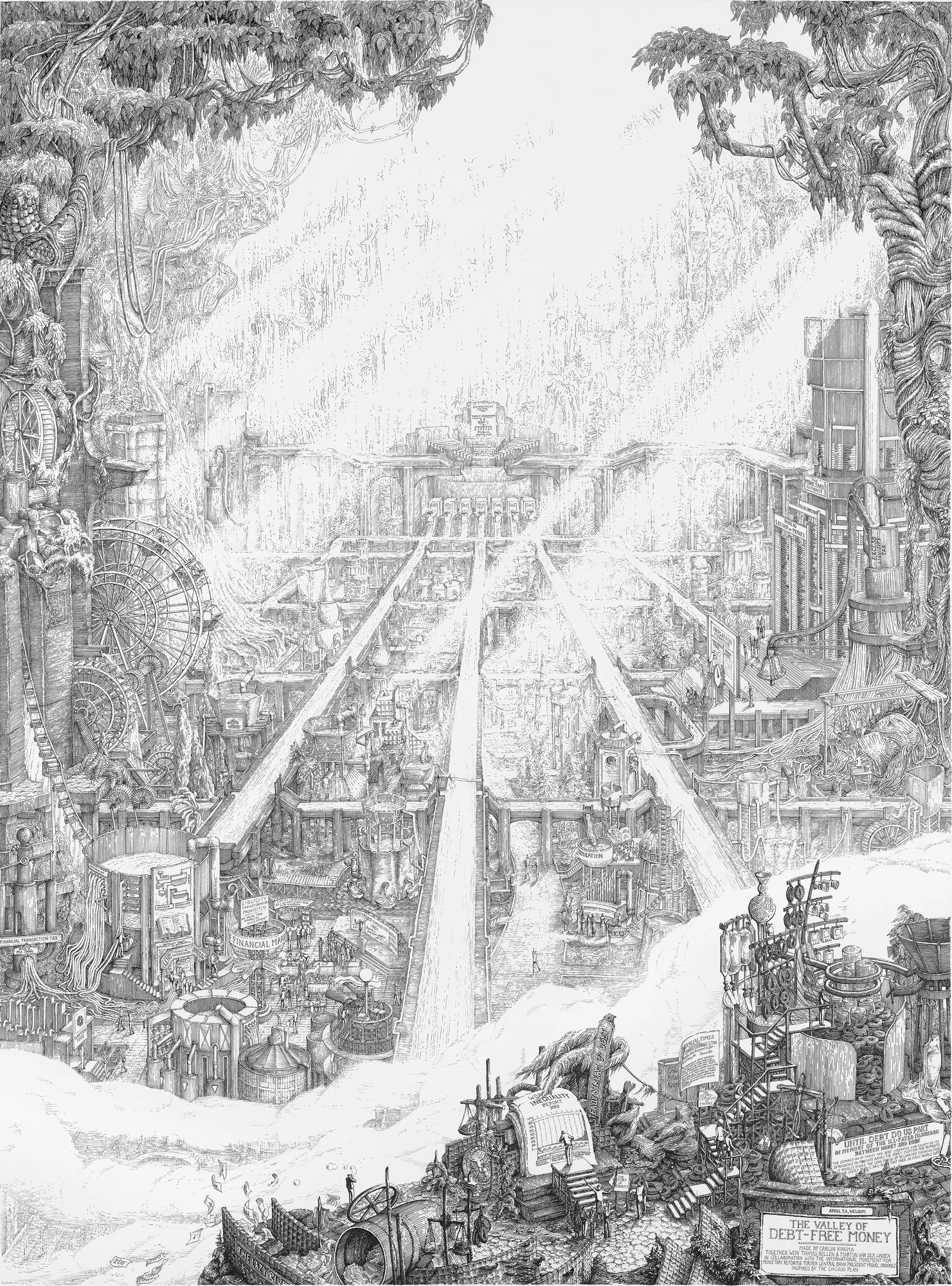
The Valley of Debt-Free Money
Until debt do us part, in memory of the ill-fated marriage between money and debt
- Year
- 2023
- Medium
- Rotring pen on museum paper
- Size
- 76 x 56 cm
- Collaboration
- In collaboration with the International Movement for Monetary Reform and former president of the Spanish central bank Miguel Ordonez. A production of cartographer Carlijn Kingma in collaboration with investigative journalist Thomas Bollen and researcher Martijn Jeroen van der Linden
- On view now
- Upcoming
- Museum editions
- Available as a limited giclée edition. View in the shop
Until debt do us part
Welcome to The Valley of Debt-Free Money. My name is Deborah. I used to be an investment banker. It was my job to make rich people even richer, by making their money work for them. But since the citizens demanded monetary reform a lot has changed. Also for me. My former job no longer exists. Nowadays I guide people through our new world where the ill-fated marriage between money and debt has come to an end. I had my day, but let’s not repeat the mistakes of the past.
Financial illiteracy
“There is a reason it used to be a crime in the Confederate states to teach a slave to read: Literacy is power.” These are the words of US financial journalist Matt Taibbi. In his famous 2009 polemic, he tried to raise awareness of the financial illiteracy that kept debt-slavery going, well into the 21st century. By making the world of finance needlessly complex, the bankers of old had turned our democracy into a two-tiered state, “with plugged-in financial bureaucrats above and clueless customers below.”
It was only with The Radical Transparency Act, enacted at the height of the Ultimate Financial Crisis, that slavery was finally abolished in all its forms, also the ones to which people in the early 21st century had complacently turned a blind eye.
Though not officially owned by anyone, a large segment of the population had to borrow money to pay for life’s most basic necessities. They were then forced to slave away their precious time in sweatshops, warehouses, and cubicle farms in return for a meager salary. If they were lucky, their pay covered the interest on the mortgages and personal lines of credit they took out to provide their families with food and shelter.
Today, the importance of financial literacy is recognized by all. It is now quite common that children learn to read financial ledgers before they can recite the alphabet without mistakes.
“Isn’t it awful?”
These words were heard often at 21st-century dinner parties, fundraisers, and sustainability events. We said them in response to all kinds of things, from squalid working conditions, to the fact that young people couldn’t afford to buy a home, to the disappearance of the purple-winged ground-dove from the Brazilian rainforest.
Crying out “isn’t it awful” had a remarkable effect—if only on one’s self-image. It made us instantly feel so much better about ourselves that it took away any pressure to actually do something about the root cause of these injustices: the flow of money (or lack thereof). While half the world’s population had almost no access to liquidity, the banking sector kept flooding corporations and their ultrarich shareholders with easy money. While burying citizens beneath a mountain of debt.
Putting your money where your mouth is
In the old world, people kept their life savings in bank accounts and mandatory pension funds, often unaware that bankers were using their money to fund ventures that worsened inequality and depleted our natural world. The only thing people saw (or wanted to see) were flashy facades with slogans about growing a better world and annual letters from management about banking for better for generations to come. As long as the returns kept flowing in, our clients asked no questions.
The Radical Transparency Act ended this practice. The Act required banks and investment funds to explicitly disclose where every euro or dollar from their customers was invested. This gave rise to a different attitude: “Put your money where your mouth is.”
The 21st century trend called “impact investing” turned out to involve little more than lip service to investing in socially responsible projects. Instead of simply putting their money “in the bank,” most people now actively invest in their community and their world, and everyone can be held accountable for the social and environmental consequences of their choices. As a result, big banks lost their market share to cooperative investment funds, credit unions, direct lending platforms, and crowdfunding initiatives that moved money in fundamentally different ways.
To discourage short-term speculation, flash-trading, and other parasitic acts by financial intermediaries, the Tobin tax was introduced. Named after the US economist James Tobin, the tax was levied on all financial transactions.
The best paid civil servants
It’s hard to believe, but in the old world the important public function of money creation was performed by privately owned commercial banks. The government was only involved through an institution that had no democratic accountability and was run by the bankers themselves. They called it the central bank (or the Fed in the US).
But the central bank didn’t control the money supply. Central banks had to rely on the cooperation of commercial banks, which were tasked with creating state-backed money. Commercial banks conjured up new money with every bank loan they granted. The more loans they provided, the more money they created, and the more money creation profit, so-called seigniorage income, was earned. This income did not flow back to the government but boosted bank profits instead. Bankers were long seen as the best paid “civil servants” on earth. I was one of them.
A mountain of debt
Didn’t commercial banks take advantage of this privilege, creating too much money and debt whenever markets went up and too little during a downturn? Wouldn’t that lead to asset price inflation and housing market speculation, while crowding out productive investments? These are among the most frequently asked questions school children voice during their yearly visit to the Museum of Monetary History.
The answers are self-evident. Of course we, the bankers, took advantage of these great opportunities to earn ourselves a nice bonus. Wouldn’t you do the same? With recurring bank runs as an inherent feature of the banking system’s design, it could only survive with public backstops. Even our youngest citizens can explain why this formula of “privatizing profits and socializing losses” generated a moral hazard that saw banks creating more and more money and an equal amount of debt. While the banks saw higher profits, global debt soared to a staggering 350 per cent of GDP in 2021. Inequality grew further.
The monetary authority
After the Great Depression of the 1930s scholars had already demanded the decoupling of money and debt-creation in their “Chicago Plan for monetary reform”. After the crisis of 2008, this plan was updated for the digital age by a new generation of scientists and citizen initiatives. The powerful banking lobby, however, succeeded in branding their proposals as “too radical.”
A digital form of public money was only introduced in the late 2020s, bearing the most unsexy name imaginable: Central Bank Digital Currency, or CBDC. On top of the plain name, its features were also limited, an attempt to protect the profitability of the then still-powerful banking cartel. But despite these shortcomings, the CBDC opened the door to further reform.
Following another spree of bank runs, banks were prohibited from financing long-term investments using direct-demand funds. They eventually lost their privileges to create state-guaranteed money. We also got rid of the central banks. Now we have our Monetary Authority, a democratically accountable institution that creates and registers the public money supply on its ledger. It’s like a public aqueduct that waters all parts of society with debt-free money.
Nowadays we wonder in amazement: how could people accept that money and debt were two sides of the same coin for such a long time? And that isn’t the only thing we now look back upon with bewilderment. Even the excess liquidity tax on uninvested funds above 250,000—now an indispensable source of government funding—had not yet been implemented. No wonder so many public facilities were of such poor quality!
Statements were recovered that appear to have been made by Miguel Fernández Ordóñez, a central bank governor who later became a monetary reformer. They shed a light on why he and his fellow central bankers failed to act. He said: ”When you’re constantly trying to avoid total collapse of the system, there’s little time to study the fundamental causes of instability.” Only three years after retiring did he realize how blind he’d been to an obvious first step toward a better system: giving citizens direct access to a digital form of safe public money. “It’s very difficult to make people criticize the institutions that pay their salaries,” Ordóñez later admitted.
As a former banker myself I can only agree. But oh boy, do I miss my yacht, watching those sunsets with a glass of champagne in my hand.