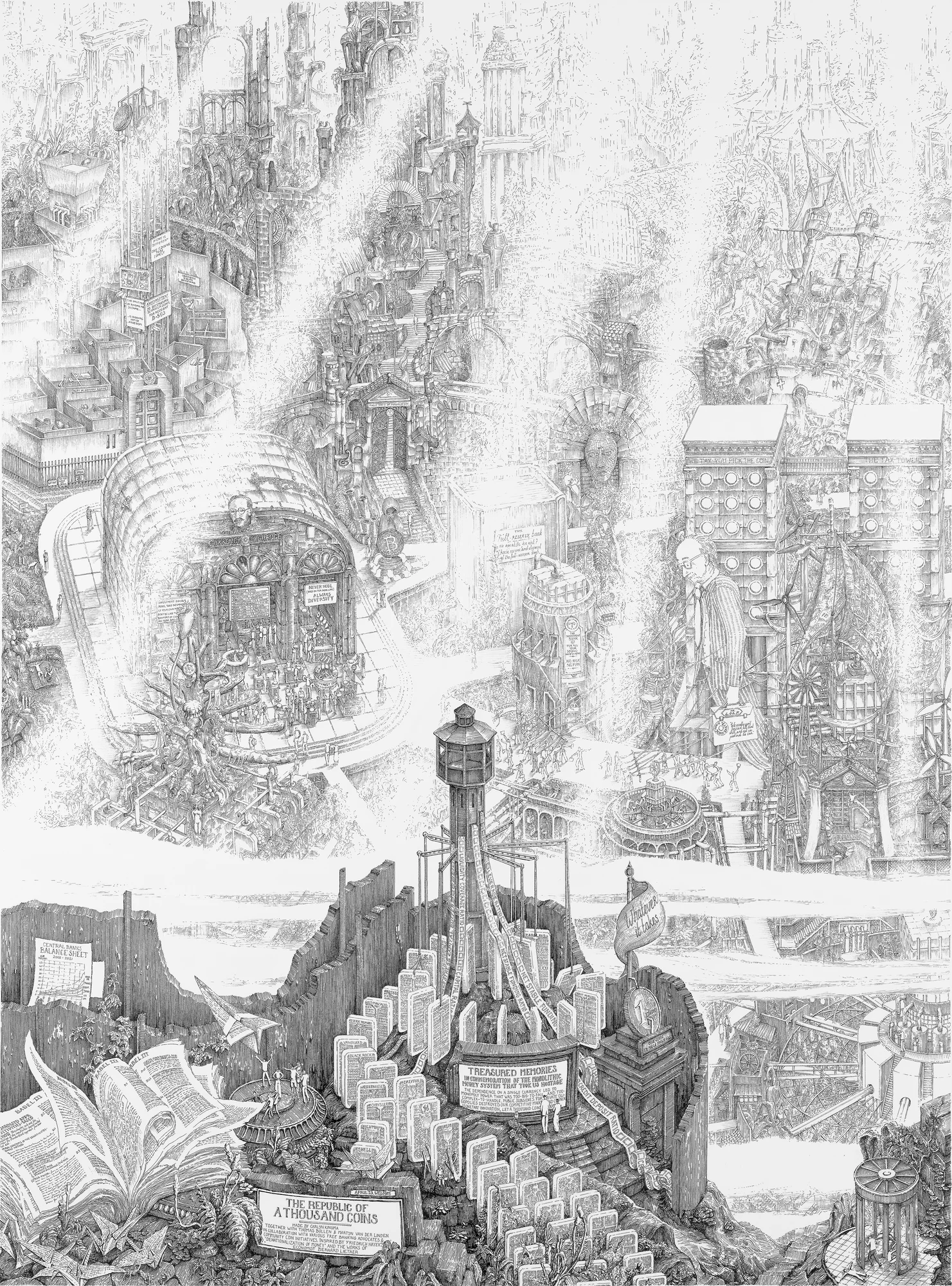
The Republic of a Thousand Coins
Treasured memories, in commemoration of the monolithic money system that took us hostage
- Year
- 2023
- Medium
- Rotring pen on museum paper
- Size
- 76 x 56 cm
- Collaboration
- In collaboration with various free banking advocates and community coin initiatives. A production of cartographer Carlijn Kingma in collaboration with investigative journalist Thomas Bollen and researcher Martijn Jeroen van der Linden
- On view now
- Upcoming
- Museum editions
- Available as a limited giclée edition. View in the shop
One coin to rule them all
In the old world, people were forced to pay taxes in their country’s national currency. Freedom of coin did not yet exist. Famous examples of such ancient national currencies were the British Pound and the US Dollar. They were essential tools in the expansion of the British and American empires. The demise of their currency heralded the collapse of these imperial powers that once ruled the world.
Perhaps the most well-known failed currency was a coin called the “Euro”. Conceived by megalomaniac politicians and central bankers in the late 20th century, the Euro was designed to be the “one coin to rule them all”. For a few decades powerful people would do “Whatever it takes” to postpone its inevitable downfall. Their hubris finally came to an end when the Ultimate Financial Crisis hit. The people of Europe lost faith in the Euro experiment and joined the blossoming monetary ecosystem of coins we know today. Now the Euro serves as the textbook example of how inflexible such monolithic money systems tend to be and the severe economic problems they can cause.
The hostage situation
The most striking design flaw, and the one which ultimately led to the downfall of national currencies, was the fact that governments determined which coin would be accepted for public use, while commercial banks were given the privilege of issuing the money. This privilege gave rise to perverse incentives in the system. Predatory banking practices, hostile takeovers, and excessive risk-taking were rewarded, resulting in a highly concentrated market. A select group of homogenous banks was lined up like dominoes. One small shock and the whole payment system could come crashing down, leaving economic mayhem in its wake.
This setup allowed an oligopoly of big banks to hold the government hostage. Banks would pocket the profits when times were good, while society was expected to pick up the tab if the tide turned. Whenever their reckless risks backfired, these too-big-to-fail banks, their shareholders, and their high-profile depositors then demanded public lifelines and bailouts. Time and again the state gave in to the banks’ demands. Taxpayer money, as well as freshly minted state money from the central banks, ended up in the coffers of bankers.
The fall of central banking
At the start of the 21st century, central banks were arguably the most influential institutions in the world. Officially they were appointed to supervise the sector, to ensure it would provide a fair and stable monetary system. But instead of serving the public interest, the central banks became the guardians of bank profitability. One of the revolving doors between the commercial banks and their regulator was dug up in recent excavations and put on display.
We celebrate our freedom each year on that popular holiday, The End of Central Banking Day, marking the end of the big banking monopoly and the birth of monetary competition. Parades are held that rival the wildest Carnival festivities, and everybody dresses up. You’ll see mock bankers among the costumed, sporting oversized suits with white dress shirts and drab, unimaginative neckties—and of course toting the obligatory briefcase.
Babel III
Highlight of the day is a silly competition for a cash prize, consisting of one unit of all available currencies in the world. It’s awarded to the individual who can get the furthest without making a mistake when reading aloud from the old banking tome, the Basel III, which most people now consider a ridiculously bloated work. Counting three times more pages than the Bible “Basel III” is commonly referred to as “Babel III”.
As big believers in democracy and decentralization, people today see the drafters of the Basel rulebook—the Bank of International Settlements, or BIS—as a frightful institution. Overregulation of money matters posed a barrier to entering the market, stifled competition, and placed too much power in the hands of a few unelected bankers. Old speeches by the former BIS governors, like Agustín Carstens, are now being screened in cinemas as scary movies.
On ordinary days, too, we make fun of the central bankers of old and their illusions of top-down control. Historical balance sheets and inflation forecasts put out by the central banks during the years leading up to the Ultimate Financial Crisis were recently discovered. They are being used to teach university students about the dangers of groupthink, goal reasoning, and wishful thinking.
Creative destruction
Faced with the crisis, the government first tried to break up the banking oligopoly, then switched to a more radical strategy. Not only were banks stopped from issuing state money, but state money itself was abandoned. For the first time in history, we now have a truly competitive money market where everyone can issue their own coin. Citizens enjoy the freedom to use a variety of currencies that all have their own designs, values, and risk profiles.
Fierce antitrust laws ensure none of the currencies can become too big, as competition is paramount. The pressure of competition has a disciplining effect on coin issuers and money managers, making them far more prudent. That has calmed the capricious business cycle’s extreme highs and lows, flattening the wild price fluctuations that plagued our continent in the past.
Public safety nets or bailouts do not exist for any of the coins. The creative destruction applauded by economist Joseph Schumpeter can be seen everywhere: only healthy currencies survive and flourish. Sometimes people have to take losses, but diversification makes the personal impact bearable. The ecosystem of currencies as a whole is now much more resilient.
A decentralized economy
Coin diversity gave rise to the emergence of local and international communities with a range of governance structures and underlying ideologies. This ecosystem of currencies has also decentralized the real economy. Small and mid-sized companies have regained market share and local markets are flourishing. That’s because communities today can use currency design to protect their economies, from the large capital in- and outflows that were so destabilizing back in the era of monetary imperialism.
Digital technology has made it possible to program social and ecological values into the monetary system. This feature eliminates the need for excessive government control or monitoring. Although, those who prefer this kind of society have founded their own community, idealizing books like We, 1984, and Brave New World. Others, like myself, are committed to transparency and a free press to facilitate the flow of information.
Freedom of coin
That old world preoccupation with chasing profits has all but disappeared, while ecological values and social justice now make up an integral part of the currency design process. Currencies linked to natural resources or renewable energy have enjoyed enormous popularity. They’ve proved to be the missing link for our transition to a greener and more just economy.
Any coin can be used to pay taxes, so there’s no need to hold currency you don’t support. To make this freedom of coin possible, however, the tax office had to double its capacity by building a second tower. After all, managing thousands of different coins with floating exchange rates has meant additional work for the treasury—and additional expense.
Never HODL
The transition to our current system accelerated in the late 2020s, though the first signs had emerged almost two decades before. In response to the 2008 financial crisis, a small group who was fed up with market interventions and toothless antitrust laws started experimenting with alternatives. A decentralized digital coin called bitcoin was all the rage for a brief period.
Bitcoin’s popularity, however, was also its downfall. When everyone started collecting bitcoins as an investment, folks would buy and then simply hold on for dear life, no matter what. That meant the currency never really got off the ground as a medium of exchange in daily life. Although bitcoin did not survive, it’s still widely regarded as the inspiration for moving away from state currency. Bitcoin’s mysterious founder is not forgotten. The statue of Satoshi Nakamoto remains a popular pilgrimage site to this day.
However, the bitcoin community’s mantra HODL, Hold On for Dear Life, is now seen as very foolish indeed. Kids today learn as early as kindergarten that private coins can fail and that diversifying is crucial. With the help of digital wallets, you can easily convert one currency into another. Holding your savings in multiple coins and paying with any of them now seems completely natural. Digital wallets are complemented by a physical plaza that houses not only a currency exchange but also the museum of monetary history. A bust of Friedrich Hayek, who wrote The Denationalization of Money, is carved into the museum’s facade. And the scholar Bernard Lietaer, who foresaw a future with multiple currencies back in the 20th century, is celebrated here as a visionary. I guess my name isn’t so bad afterall.