 ⓘ
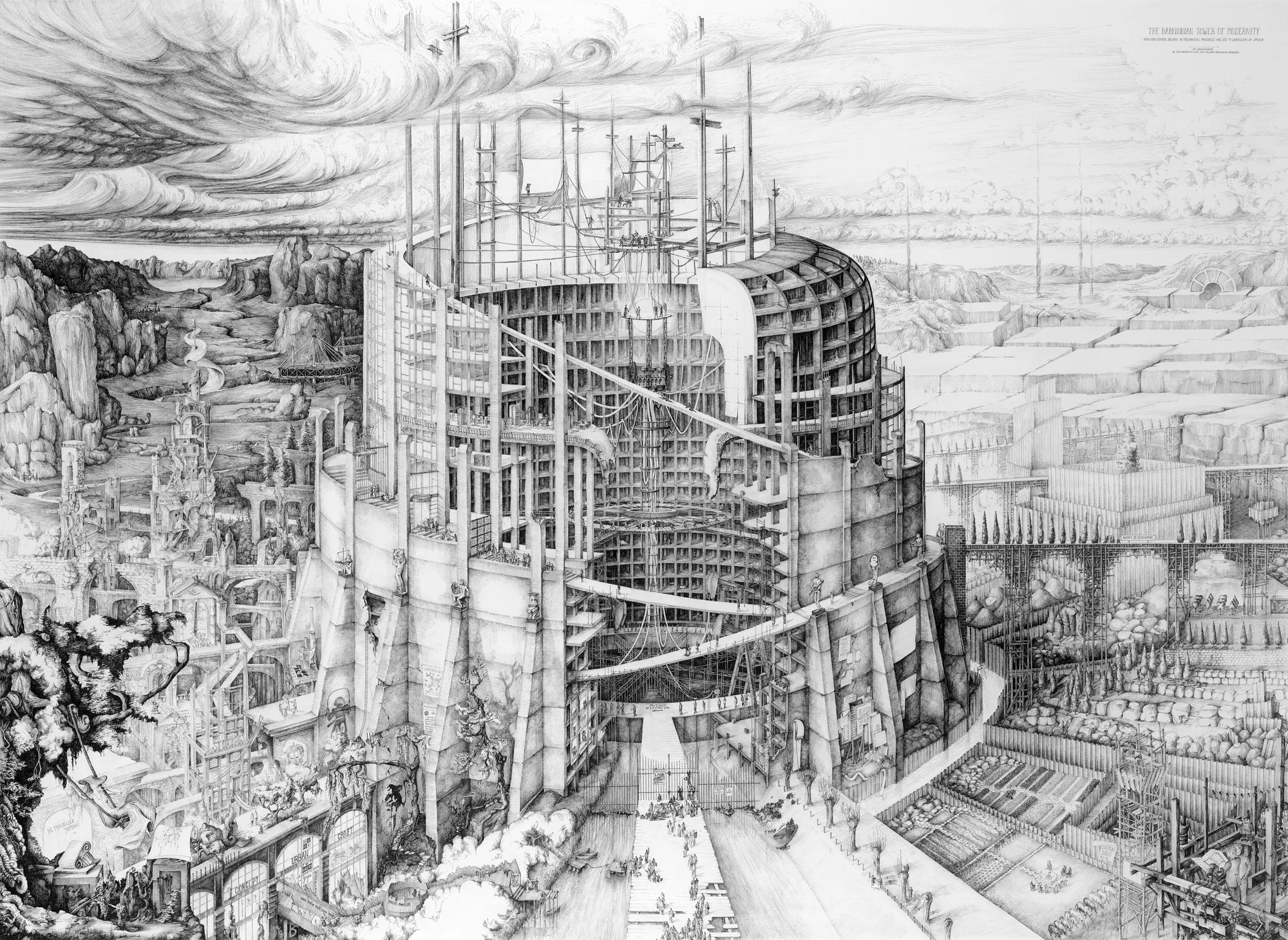
The Babylonian Tower of Modernity
How our belief in technological progress once again causes a confusion of tongues, and how our capitalist society, as a result, splits into multiple roads
- Year
- Rotterdam, 2017
- Medium
- Rotring pen on museum board
- Size
- 129 x 94 cm
- Collaboration
- Story in collaboration with the founder of Stad in de Maak, Piet Vollaard, and futurologist Edwin Gardner
- On view now
- Upcoming
- Museum editions
- This edition is sold out.
"And they said: Come, let us build ourselves a city, and a tower whose top reaches to the heavens, and let us make a name for ourselves, lest we be scattered over the whole earth!" Thus Genesis 11:4
Why do people build towers? To protect themselves against enemies? To transmit and receive TV signals? To house even more people and exploit our earth further? No, no, three times no. Lies, every one of them. Veils to hide the real function of a tower — to shout as loudly as possible, "Here I am! Look how mighty I am!"
Today we build a Babylonian tower to reach the heavens of technological progress. And as with every faith, we worship our gods. The god of progress, the god of efficiency, the god of quantity and masculinity. One by one we worship the gods from the story of ratio and reason. The goddess of change, the god of technology, and the god of a kind of equality.
Organised around the combustion engine of capitalism, we just keep producing. Everyone here has a task and a place within the hierarchy of the system. But secretly we all dream of being better, of a spot higher up. Because the higher up, the more powerful, the more prestige and influence on the engine of society. Yet for only a select few is this upward movement to the top an attainable ideal. In fact, not everyone is welcome. To get in and be allowed to join our system, you first need the right ticket. A lottery draw. And after a long journey to the gates of the tower we will, unfortunately, have to tell you that we are full. That you had better try your luck at another promised land.
But once inside, you take part, whether you want to or not. At the foot of the tower lives the social underclass. Here, raw materials are extracted and processed by the yes-men and the no-men, in the rhythm of daily routines and habits, on the avenue of everyday life. We line our identical concrete cells with attributes of individuality, searching within this serial sameness for a feeling of home and belonging.
The class above that takes care of transport to the place of combustion. But as I already said: not everyone can go up. Because to climb higher and to be higher, you must unlock several gates. First, at the bottom, the gate of origin, followed by the gates of education.
Within a functioning society we need both theorists and practitioners. People with different qualities, who complement and strengthen one another. But in the tower of modernity these qualities are not two sides of the same coin, or two equal pillars under the same weight. Already in education, the difference between theory and practice is labelled as higher and lower.
We keep climbing further up the tower of hierarchy, towards the place of combustion. Towards the engine, the computers and the programmes devised and controlled by mechanics. Here the tower's data is translated into ones and zeros. With a screen in front of your face/nose and your back to life, in contact with the machine and connected to the net, but physically no longer connected to one another. Here too people live in concrete cells, but this time a little bigger. And here and there a variation on the theme, or plastered with flying fruit.
Finally, at the very top, all of this appears to be steered by the political stronghold at the summit. But blinded by slogans and campaigns we can barely see the strings by which they, like puppets, are controlled by the capitalists and bankers. In the jungle between the peaks and symbols of our faith, there is climbing, cutting in line, and pushing. In this way it is decided, time and again, who gets to play for a while.
The rationalisation of work is the dominant driving force in our culture. Efficiency takes precedence over meaning. This makes us prosperous and powerful, but through this rationalisation we feel increasingly alienated and uprooted from our natural environment.
We are numbed by an endless rhythm of daily routines. We work eight hours, we sleep eight hours, and in the eight hours that remain we work some more. We live in a man-made environment, a climate-controlled atmosphere of concrete, steel and glass, under an artificially lit sky.
From the fortune-seekers and refugees below at the gates, to the flex-working bankers at the top, slowly but surely rising through the tower of progress, we all lose our sense of home and belonging. Because where one person cannot get a home, another rents out their room online, while our alternative living room in the café is marketed as a flex-space. The higher the tower, the greater the distance between the low-educated and the high-educated, between the haves and the have-nots; between the masses and the 1%. Ageing is increasing, as is the income gap and technological unemployment.
More and more, people feel uprooted within the dream of capitalism. Until, disgusted by ratio, our breath constricted by the poison of the engine's violence, we go in search of something new. Away from the tower, but in different directions, we search for other forms.
Through a hole in the wall we break out, straight through the walls of the tower, into the wild wilderness, in search of the place where life is still lived 'for real'. Enough of economic growth, personal growth is what we want; new bonds with ourselves, the community and nature. In search of alternatives to vacancy and other forms of living. In search of the different, the stranger, the outsiders, in search of something extraordinary. Everything must be craft, everything must be urban, and everything remains stuck at the concept stage. Usefulness gives way to the higher goal of wanting to be different. Nothing is normal anymore, passi messa, not like this but like that, or something. It is not 'how' we should work that we want to know, but 'why'. Who am I, rather than what do I have? The game, the danger, the feeling of being alive. The tower of chaos, and more. We want to live amid the Sublime, the wild nature that is greater than us. In a game, like a child, living forever in a world that is eternally changing. On the left side of this world, all the way to the horizon of time, we trust in abundance. There is enough for everyone, but how do we divide it? Authenticity, originality, spontaneity, rawness and honesty grow in importance. The system rejected in favour of the game; danger embraced as an ally.
For those who grow tired of plastic vanity, for all who are sick of the foam-rubber life, or a world for the dreamers and adventurers. Welcome to the Sublime.
On a swing in Fragonard's tree sits a somewhat young architect of this world. Cheerful, carefree, and spontaneous, unafraid and perhaps a little naive. She turns life into messy art. A chaotic quest with the burning question: how can we connect everything? Because, whether it is good or bad, once everything is connected to everything else, suddenly everything matters.
We cross over to another side, of those who have broken out. Another, extremely romantic reaction to the tower of reason in the middle. All reactions, from Beautiful to Sublime, are romantic in nature but a world of difference apart. Where, in the Sublime lands to the left, we would let the other in, in the Beautiful world to the right we transform our trees into sturdy fences. We, on the Beautiful side of the land, are superior to nature. Instead of being subordinate to fast processes, we master the art of preservation. We celebrate tradition, the birthday with visitors and conviviality around the cheese board. We remain loyal to who we are and hold on to it: Potatoes – Vegetables – Meat. We transform the world around us into the fence protecting our lawn. You cannot build on the unknown, but we are there for one another. We dominate nature — at every scale — and turn it into art. Into throbbing and pure forms. Stones into cubes, plants into hearts. And trees into bridges towards the happy Elsewhere. In search of the place where life feels right and where it does not change. In the distance we see the landscape worked into mines and quarries, and the forests burning. Not abundance, but an awareness of scarcity — how do we hold on to what is ours?
For those who grow tired of plastic vanity, for all who are sick of the foam-rubber life, or a world for those who seek shelter and stability. Welcome to the Beautiful.
From the high watchtower, the architects look out over the Beautiful land, and consider the right division. Instead of lines to connect countries, they draw lines to protect the land. The lines on the map are walls instead of bridges. How high should the fence become? Equal to one another, but against the rest. And well organised. What will be the blueprint of our lives, of our routines and traditions? And how do we ensure — until the end of time — that life is good and stays good.
It seems an impossible task, gaining insight into the endlessly complex and dynamic culture we call modernity. And whenever we try to agree on the answer to the question of where we should go, all sides, from Beautiful to Sublime, suddenly stand diametrically opposed to one another. By the gods of progress, a Babylonian confusion of tongues has once again been imposed on us. So that we no longer understand one another. Sometimes it almost seems as if we have forgotten that we are all reacting to the same system. But as long as we keep pointing fingers and remain stubborn — the unstable tower of present-day Babel quietly keeps growing.
Previously on view
-
29th of March - 31st of August 2025
Kunstmuseum Den Haag
Group exhibition: New New Babylon - Visions of Another Tomorrow
On display: The Babylonian Tower of Modernity -
28th - 30th of November 2018
World Architecture Festival.
Exhibition The Babylonian Tower of Modernity
-
October - November 2018
Sir John SOANE's Museum, London.
Group exhibition