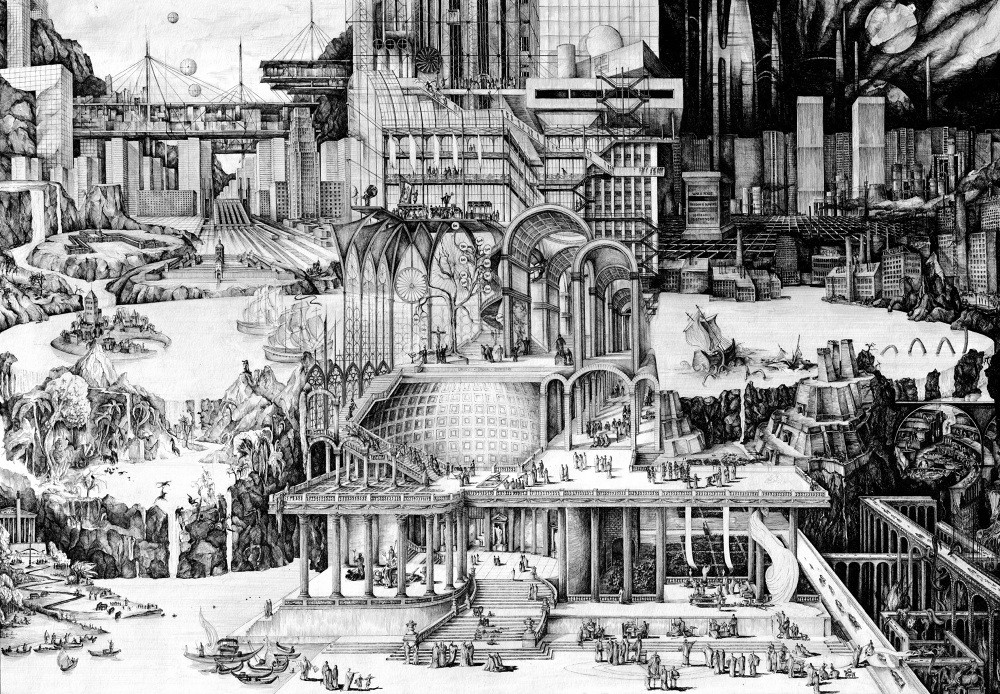
A History of the Utopian Tradition
Een reis door de wereld van de westerse Utopie om te begrijpen hoe de realiteit zich altijd heeft gevormd tussen onze angsten en onze verlangens
- Year
- April 2016
- Medium
- Chinese Ink and dip pen on paper
- Size
- 1189 x 841 mm
- Collaboration
- Gemaakt in samenwerking met Patrick Healy en Robert Nottrot. Gebaseerd op 42 utopische geschriften (in de breedste zin van het woord). Geïnspireerd op de ideeën van onder andere Rutger Bregman, Lewis Mumford, Manuel Lima en Donna Haraway
- Edition
- Prints are available in high quality fine art giclee print on heavy Hahnemühle paper (310 gr). Limited edition of 7 large size prints and 70 small size prints. The prints are signed and numbered. The prints are accompanied with a booklet, which, like a journey along the details of the drawing, explains the history of the utopian tradition
- On view now
- Upcoming
- Museum editions
- This edition is sold out.
The urge to transcend and push life ‘as it is’ in order to move towards life ‘as it should be’, is a defining feature of humanity. Utopia is a way of articulating of this urge – a project or vision which provides us with a clear view on an alternative present or future world, through which, although sometimes just for one little moment, we can believe in something extraordinary. Utopia has long been the name for the unreal and the impossible. We have set utopia over against the world as the world of dreams, fantasies and ideas. Thus, sometimes, we seem to forget, that, like Lewis Mumford used to say, the choice we have is not between reasonable proposals and an unreasonable utopianism. Utopian thinking does not under- mine or discount real reforms. Indeed, it is almost the opposite: practical reforms depend on utopian dreaming. It encourages us in our efforts, and sets a beacon in the uncharted seas of the distant future, and in doing so drives to incremental improvements. The world needs utopia, as the cities and mansions that people dream of are those in which they finally live.
For as long as we exist, we have imagined the things that ought to be. The Greeks knew such wise men as philosophers, they allowed them great freedom and rejoiced in the mathematical precision with which their intellectual leaders mapped out those theoretical roads which were to lead mankind from chaos to an ordered state of society. The Old Tes- tament used to call such people prophets, insisting with narrow persistence upon the King- dom of Heaven as the only possible standard for a decent Christian Utopia. The sixteenth and seventeenth centuries fought many bitter wars to decide the exact nature of a white- washed Paradise, erected upon the crumbling ruins of the medieval church. The eighteenth century saw the Promised Land lying just across the terrible bulwark of stupidity and super- stition, which a thousand years of clerical selfishness had erected for its own protection and safety. There followed a mighty battle to crush the infamy of ignorance and bring about an era of well-balanced reason. Unfortunately, a few enthusiasts carried the matter a trifle too far. Napoleon, realist-in-chief of all time, brought the world back to the common ground of solid facts. In response, the twentieth century grew a counter-culture of everything fixed and finite, and presented utopia with its twin brother, the anti-utopia, which by opposing utopia also made her stronger. But in recent decades something has changed. Many observe utopia and their sympathizers as foolhardy dreamers at best and murderous totalitarians at worst. If the utopian spirit has proved to be a tool to trigger progress and improvements, then the recent growing suspicion towards utopia and the growing anti-utopian library is worrisome. Over the last century Utopia has gained a historic record of “anti-utopian” novels and instead of worrying how we can get to the good place we now think about how we can prevent the ‘utopian project’ from being realized. How did this happen? And as the will-to- transcend will always remain, how can we make the utopian project, our beacon leading us to conscious progress and change, legitimate and valuable again?
Understanding where utopia stands today is to understand its past, where it comes from and what ideas it carried. The first part of this thesis is an attempt to set out, mainly in drawing, supported by text, the general pattern of utopian writing in the West. Setting out the history of utopian writing is not meant principally as an historiographical exercise, but is necessary for understanding and thinking about the fate of utopia in our own times, and its possibilities for the future. Through history we learn how utopia always emerges and exists under specific circumstances. At the same time, the content and articulation of utopia has always been bonded to a set of attributes such as the organization of knowledge; power; the interpretation of territory; and time, resulting in the question of finality. Understanding the changing utopian tradition as a result of the changing attributes of the material world in the past, can help us understand the recently emerged suspicion of the utopia today, and hand us the tools to resonate on the possibility of a post-modern utopia tomorrow.
An inevitable part of the utopian tradition is the art of storytelling, and therefor, this elab- oration on the changing tradition of the utopia of the west is done mainly through image and illustrated with words. Image 1. History of the Utopian tradition, shows an overview of the whole story. Our journey begins in ancient Greece, with the Republic of Plato, as we work ourselves up to the utopian visions of the 20th century. A sequence of fragments, taken from the main image, will guide us through the story, handing us the possibility to not only understand each utopia as a separate entity or a product of its time, but also to understand each story as a part of a changing utopian tradition.
[...] Ch. 1 - Ch. 7 are left out but are available in print.